Русский
 Deutsch
 Español
 Français


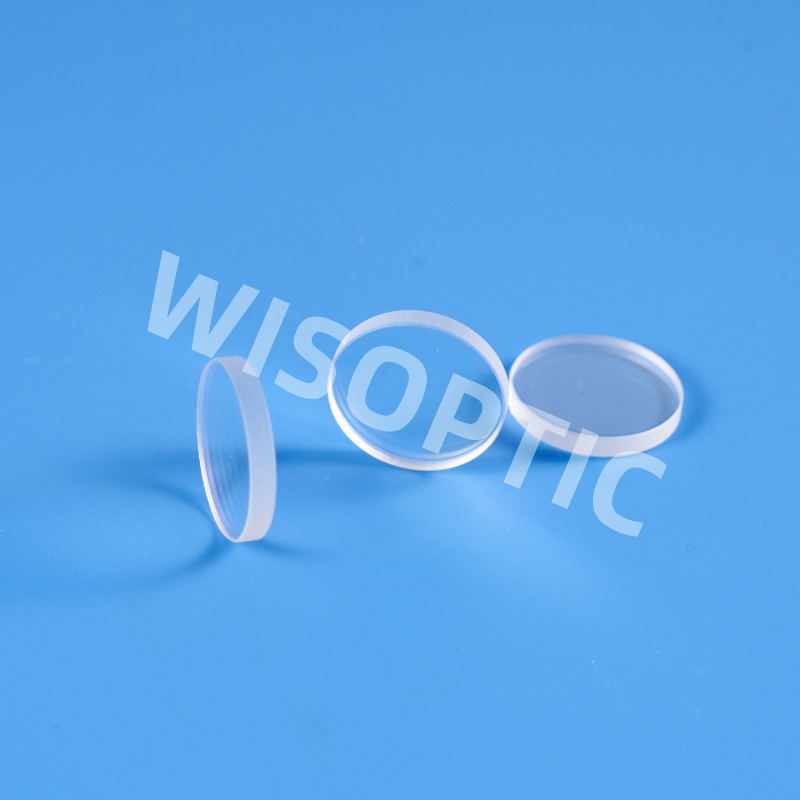
KDP&DKDP Crystal
• High deuteration ratio (>98.0%)
• High homogeneity
• Excellent internal quality
• Top finish quality with high processing precision
• Large block for various size and shapes
• Very competitive price
• Mass production, quick delivery
KDP (KH2PO4 ) and DKDP/KD*P (KD2PO4 ) are among the most widely-used commercial NLO materials. With good UV transmission, high damage threshold, and high birefringence, these material are usually used for doubling, tripling and quadrupling of Nd:YAG laser.

With high E-O coefficient, KDP and DKDP crystals are also widely used to make Pockels cells for laser system, such as Nd:YAG, Nd:YLF, Ti-Sapphire, Alexandrite, etc. Even though DKDP with high deuteration is more commonly used, KDP and DKDP both can do phase matching of type I and type II for the SHG and THG of 1064nm Nd:YAG laser. We recommend KDP for FGH of Nd:YAG laser (266nm).

As one of the major KDP/DKDP suppliers (source manufacturer) in the whole international market, WISOPTIC has high capability of material selection, processing (polishing, coating, gold-plating, etc). WISOPTIC confirms reasonable price, mass production, quick delivery and long guarantee period of these materials.

WISOPTIC Standard Specifications* - KDP/DKDP
Deuteration Ratio | > 98.00% |
Dimension Tolerance | ± 0.1 mm |
Angle Tolerance | ≤ ± 0.25° |
Flatness | < λ/8 @ 632.8 nm |
Surface Quality | < 20/10 [S/D] (MIL-PRF-13830B) |
Parallelism | < 20” |
Perpendicularity | ≤ 5' |
Chamfer | ≤ 0.2mm @ 45° |
Transmitted Wavefront Distortion | < λ/8 @ 632.8 nm |
Clear Aperture | > 90% of central area |
Laser Damage Threshold | > 500 MW for 1064nm, TEM00, 10ns, 10Hz (AR-coated) |
* Products with special requirement upon request. | |
Main Features - KDP/DKDP
• Good UV transmission
• High optical damage threshold
• High birefringence
• High nonlinear coefficients
Primary Applications - KDP/DKDP
• Laser frequency conversion – Second, third, and fourth harmonic generation for high pulse energy, low repetition (<100 Hz) rate lasers
• Electro-optical modulation
• Q-switching crystal for Pockels cells
Physical Properties - KDP/DKDP
Crystal | KDP | DKDP |
Chemical formula | KH2PO4 | KD2PO4 |
Crystal structure | I42d | I42d |
Space group | Tetragonal | Tetragonal |
Point group | 42m | 42m |
Lattice constants | a=7.448 Å, c=6.977 Å | a=7.470 Å, c=6.977 Å |
Density | 2.332 g/cm3 | 2.355 g/cm3 |
Mohs hardness | 2.5 | 2.5 |
Melting point | 253 °C | 253 °C |
Curie temperature | -150 °C | -50 °C |
Thermal conductivity [W/(m·K)] | k11= 1.9×10⁻² | k11= 1.9×10⁻², k33= 2.1×10⁻² |
Thermal expansion coefficients (K-1) | a11= 2.5×10⁻⁵, a33= 4.4×10⁻⁵ | a11= 1.9×10⁻⁵, a33= 4.4×10⁻⁵ |
Hygroscopicity | high | high |
Optical Properties - KDP/DKDP
Crystal | KDP | DKDP |
Transparency region | 176-1400 nm | 200-1800 nm |
Linear absorption coefficients | 0.04 /cm | 0.005 /cm |
Refractive indices (@1064 nm) | no=1.4938, ne=1.4601 | no=1.5066, ne=1.4681 |
NLO coefficients (@1064 nm) | d36=0.39 pm/V | d36=0.37 pm/V |
Electro-optic coefficients | r41=8.8 pm/V, r63=10.3 pm/V | r41=8.8pm/V,r63=25 pm/V |
Longitudinal half-wave voltage | 7.65 kV (λ=546 nm) | 2.98 kV (λ=546 nm) |
SHG conversion efficiency | 20~30% | 40~70% |
Phase matching angle for SHG of 1064 nm
KDP | DKDP | |||
Type of phase matching | Type 1 ooe | Type 2 eoe | Type 1 ooe | Type 2 eoe |
Cut angle θ | 41.2° | 59.1° | 36.6° | 53.7° |
Acceptances for crystal of 1 cm length (FWHM): | ||||
Δθ (angle) | 1.1 mrad | 2.2 mrad | 1.2 mrad | 2.3 mrad |
ΔΤ (thermal) | 10 K | 11.8 K | 32.5 K | 29.4 K |
Δλ (spectral) | 21 nm | 4.5 nm | 6.6 nm | 4.2 nm |
Walk-off angle | 28 mrad | 25 mrad | 25 mrad | 25 mrad |
KDP&DKDP Crystal Test Report