Русский
 Deutsch
 Español
 Français


Research on Mid-Infrared Parametric Oscillators - Part 07
3.2 Output Characteristics of OPO
To further investigate the impact of the reversal effect on the output laser characteristics, a photodetector was used to monitor the time-domain signals of the remaining pump laser at the highest pump power using a PBS (www.wisoptic.com) at output mirror transmittances of 0% and 30%, as shown in Figure 10. It can be seen that when the output mirror is highly reflective, the power density at the trailing edge of the remaining pump pulse width increases rapidly, indicating that under high-power pumping, three-wave energy backflow occurs, and the reversal phenomenon severely reduces the optical-to-optical conversion efficiency. When the output mirror reflectance is 30%, the pulse trailing edge also shows an increasing trend, indicating that at this pump power, the reversal effect just begins to appear. Compared to the case of a highly reflective output mirror, the three-wave energy backflow is smaller, the reversal effect is weaker, and the optical-to-optical conversion efficiency tends to stabilize. Experiments show that under low-power pumping, due to the low power density inside the cavity, the transmittance of the output mirror can be reduced to improve the light-to-light conversion efficiency and lower the OPO threshold. Under high-power pumping, the strong inversion effect and crystal thermal effect inside the cavity become the main reasons for the reduction in light-to-light conversion efficiency.
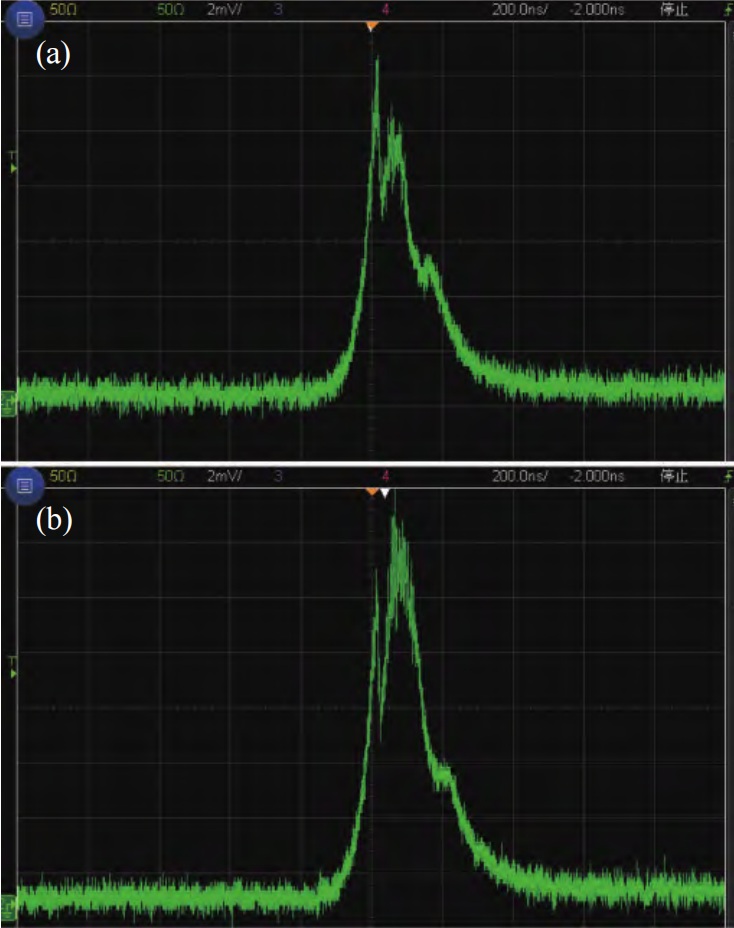
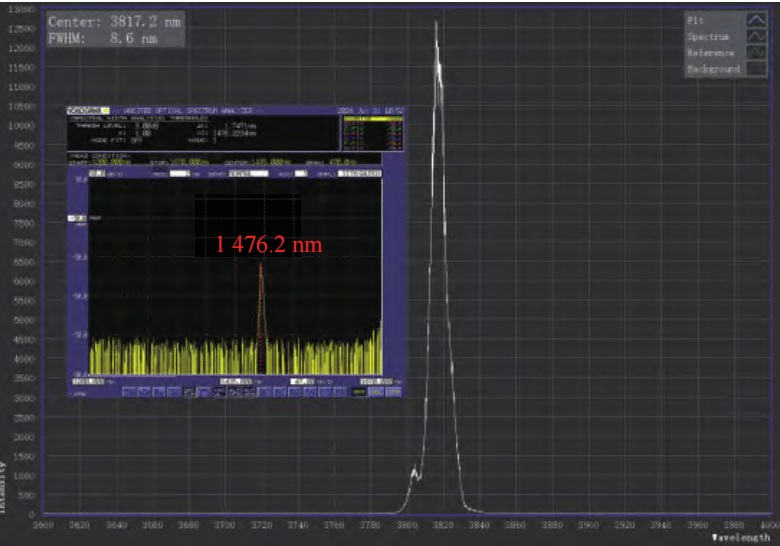
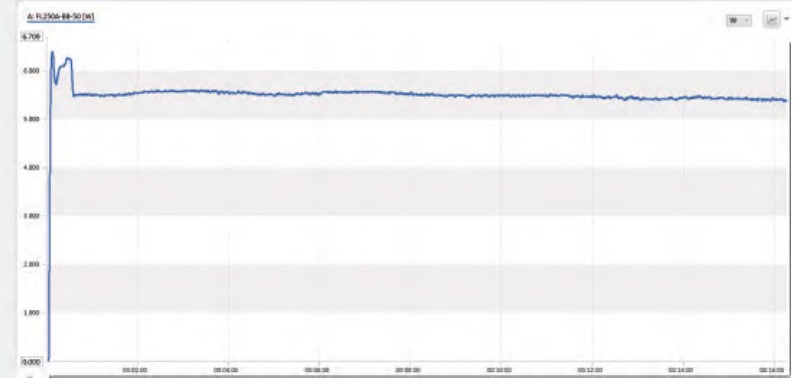
Therefore, an output mirror with a larger transmittance should be selected to improve the light-to-light conversion efficiency and stability of OPO under high-power pumping. The wavelengths of the signal and idler beams were measured using a mid-infrared and near-infrared spectrometer, as shown in Figure 11. The center wavelength of the idler beam was 3817.2 nm, and the center wavelength of the signal beam was 1476.2 nm. The experimental results showed good agreement with the theoretical results. A 250 mm lens (made of CaF2, www.wisoptic.com) was used, and the divergence angle of the output mid-infrared laser was measured using the aperture method. The divergence angle was less than 12.3 mrad. The power stability at the highest pump power and an output wavelength of 3.8 μm was tested, and the results are shown in Figure 12. During the initial high-power pumping stage, the output power decreased slightly due to thermal effects. The root mean square (RMS) of instability within 15 minutes after power stability was calculated to be 1.97%.
4. Conclusions
This paper studies a high-power mid-infrared OPO laser based on MgO:PPLN (www.wisoptic.com). At a maximum pump power of 43.7 W, the maximum output power of the 3817 nm laser is 5.93 W, with an optical-to-optical conversion efficiency of 13.5%. The temporal characteristics of the signal light and residual pump light under high-power pumping are studied and analyzed. It is concluded that the decrease in optical-to-optical efficiency under high-power pumping is caused by both the reversal effect and the crystal thermal effect. The selection of output cavity mirror transmittance for different pump power levels is also analyzed. Compared with previous literature reports, this study uses a broadband fiber Q-switched pulsed laser produced in China and domestically produced MgO:PPLN crystal, significantly reducing technical difficulty, development cycle, and cost.